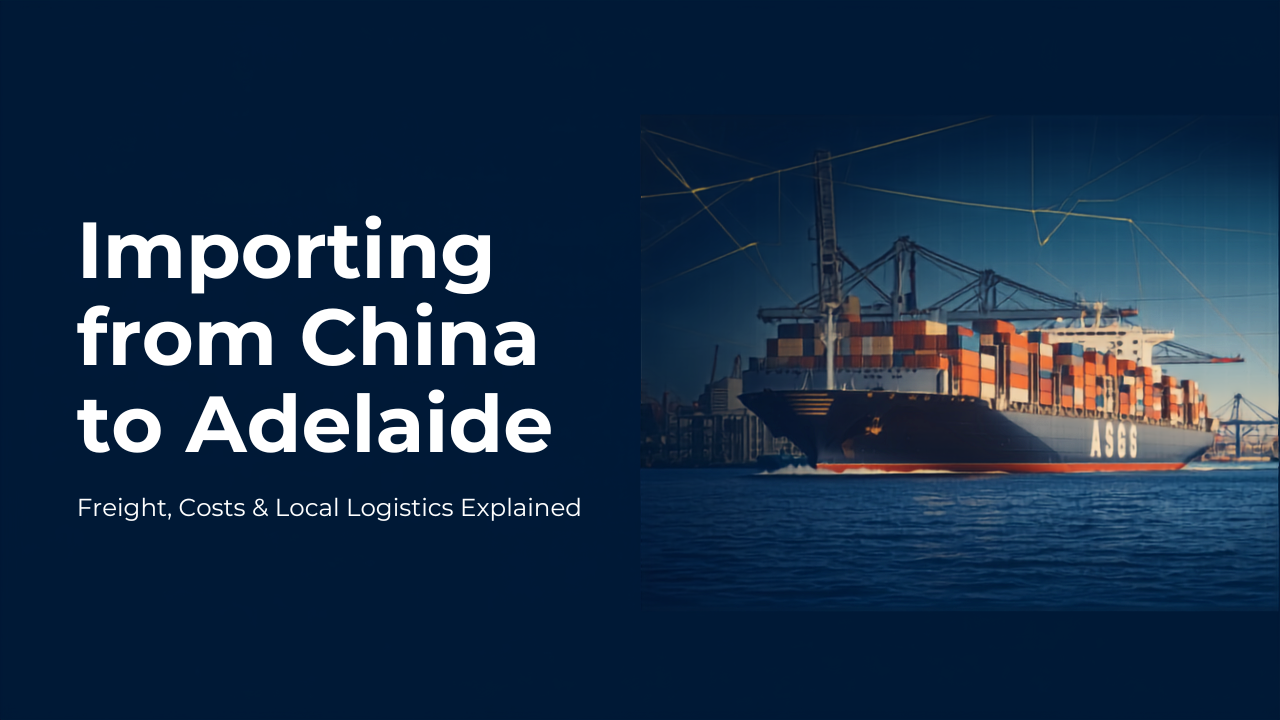
Importing from China to Adelaide, step by step. We cover Port Adelaide/Outer Harbor logistics, realistic shipping times, a worked landed-cost example in AUD, and the South Australian quirks worth knowing.
Last updated: 21 June 2026
In short: Importing products from China to Adelaide follows the same core process as any Australian port — find a verified supplier, order samples, run quality control, arrange freight, and clear customs — but with a few South Australian quirks worth knowing. Most container freight arrives at Outer Harbor (Port Adelaide), and SA's smaller import volumes mean shipping schedules can be less frequent than Sydney or Melbourne, so plan lead times generously. Expect a realistic door-to-door timeline of 6–10 weeks and budget for duty, 10% GST, and clearance on top of your factory price. A sourcing agent removes most of the risk and admin from the equation.
Absolutely. Adelaide importers bring in goods from China every day, and you don't need to route everything through Sydney or Melbourne. Container ships call directly at Outer Harbor at Port Adelaide, and air freight lands at Adelaide Airport. The process is identical to any other Australian capital — the differences are mostly about freight frequency and local logistics, which we'll cover below. For the broader national picture, see our importing from China to Australia service page.
At Epic Sourcing we've sourced 20,000+ products for 300+ happy clients across Australia, with average savings around 77%. Adelaide-based manufacturers, retailers and online sellers use the same playbook as everyone else: go direct to the factory, control quality, and pocket the margin that local wholesalers would otherwise take.
Here's the full sequence, start to finish.
Source candidates on platforms like Alibaba or 1688, or through a sourcing agent's existing factory network. Verify each one — confirm they actually manufacture the product, check business licences, and review export experience. Never wire money to an unverified supplier.
Get physical samples before you commit to a bulk order. Check them against your spec, test the build quality, and confirm they meet any Australian standards that apply to your product category. Our quality control guide covers how to inspect properly.
Agree on unit price, minimum order quantity, payment terms and your Incoterm (FOB is the most common starting point). Get it in writing. If Incoterms are new to you, our Incoterms explained guide breaks them down.
Have the bulk order inspected before it leaves the factory. This is the single biggest protection against receiving a container of unsellable stock.
Book sea freight (full container FCL, or shared LCL for smaller loads) to Outer Harbor, or air freight to Adelaide Airport for urgent or high-value goods. A freight forwarder coordinates the journey.
Your customs broker lodges the import declaration, and you pay any duty plus 10% GST. Once cleared, the goods are released for local delivery. See our complete guide to customs clearance in Australia for the detail.
Sea freight transit from major Chinese ports to Outer Harbor typically runs 18–30 days, depending on the service and whether the vessel tranships through Singapore or another hub. Because South Australia handles lower container volumes than NSW or Victoria, direct sailings can be less frequent, so add buffer to your planning.
Factoring in production (often 30–45 days), QC, ocean transit and customs clearance, a realistic door-to-door timeline is 6–10 weeks. Air freight cuts the transit to around a week but costs several times more — reserve it for samples, urgent restocks or compact high-value items. Comparing capitals? See our guide to importing from China to Brisbane.
Your landed cost includes far more than the factory price. Here's a worked example for a 1,000-unit order of a homeware product shipped LCL to Adelaide.
Cost itemDetailCost (AUD)Unit price (FOB)1,000 units × $4.20$4,200Sea freight (LCL)Shenzhen → Outer Harbor$1,450Marine insurance~1.5% of value$85Customs duty5% (example tariff; many goods are 0% under ChAFTA)$210GST10% on (goods + freight + insurance + duty)$595Customs clearance & port feesBroker + Outer Harbor handling$700Local delivery (Adelaide metro)Depot to warehouse$280Total landed$7,520Landed cost per unit~$7.52
Note the duty line. Under the China-Australia Free Trade Agreement (ChAFTA), a large share of Chinese-origin goods enter duty-free with a valid Certificate of Origin — so your real duty may be $0. Always confirm your product's HS tariff code before budgeting, because it determines both the duty rate and any concessions. Not sure what the bill of lading does in all this? Our plain-English bill of lading guide explains it.
A few local realities shape how you plan:
Container freight arrives at Flinders Adelaide Container Terminal at Outer Harbor. It's efficient, but with fewer direct services than the eastern seaboard, sailing schedules matter — book early.
Lower volumes can mean longer waits for the right sailing and occasional transhipment delays. Smart Adelaide importers order earlier and hold a little more safety stock.
South Australia's agricultural sector means biosecurity is taken seriously. Timber packaging, foodstuffs and certain natural materials can trigger DAFF inspection — factor potential treatment and inspection fees into your timeline.
Australia doesn't require a general import licence for most goods, but specific products (such as certain chemicals, foods or regulated items) need permits, and everything must meet relevant Australian safety standards and DAFF biosecurity rules.
Most sea freight arrives at the Flinders Adelaide Container Terminal at Outer Harbor, Port Adelaide. Air freight lands at Adelaide Airport.
Direct to Adelaide is usually simpler and avoids double-handling. Routing via Melbourne can occasionally be cheaper on freight if sailings are limited, but you then pay interstate transport. Compare total landed cost both ways for your specific shipment.
It depends on your product's HS tariff code. Many Chinese goods qualify for 0% duty under ChAFTA with a valid Certificate of Origin; others attract 5% or more. You'll always pay 10% GST on the landed value.
Yes — location doesn't matter. A sourcing agent manages supplier vetting, pricing, QC and freight on your behalf, then delivers to your Adelaide warehouse, so you get the same access and protection as a Sydney or Melbourne importer.
Importing from China to Adelaide is straightforward once you've got the right people handling the messy bits. Our bilingual teams on the ground in China verify factories, lock in pricing, run quality control and manage freight all the way to your Adelaide warehouse. With 20,000+ products sourced, 300+ happy clients and offices in five countries, we take the risk and admin off your plate so you can focus on selling. Give us a bell or book a discovery call and we'll map out your import plan.