A practical 2026 guide for Australian wellness brands private labelling supplements and vitamins from China, covering the TGA listed vs registered pathway, landed costs and factory vetting, with a worked example and FAQ.
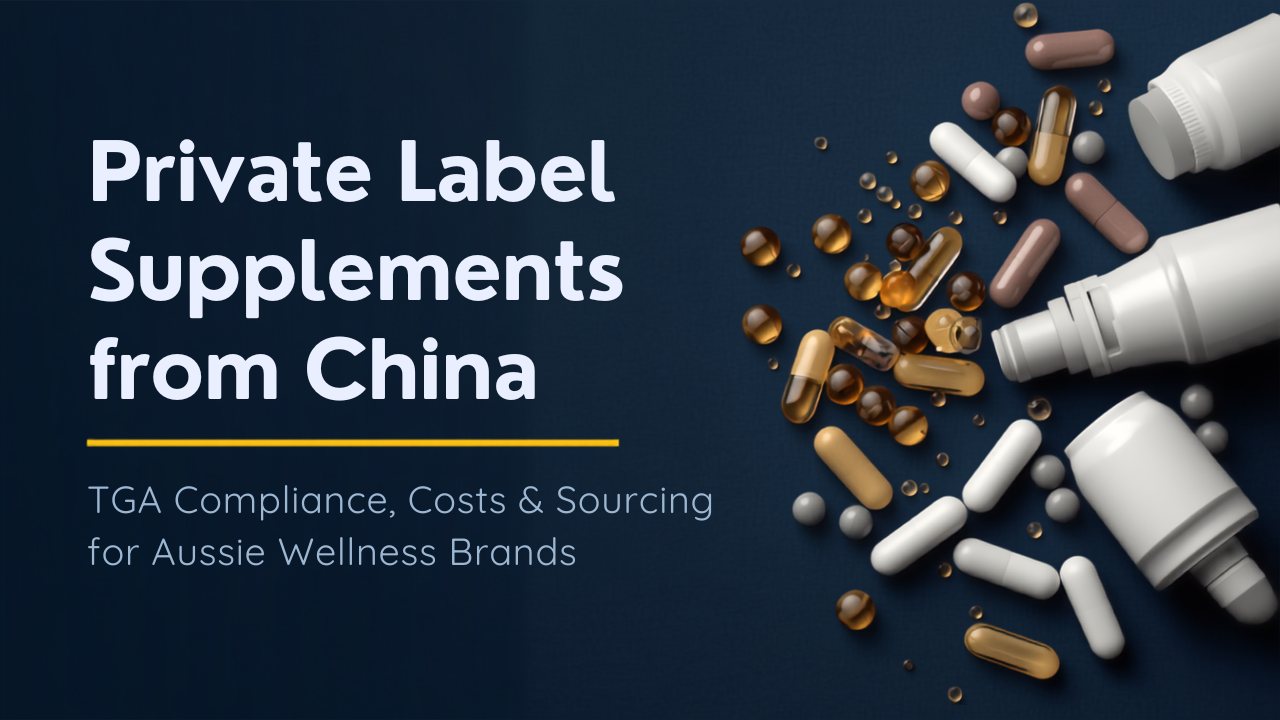
In short: Yes, Australian brands can source and private label supplements and vitamins from China, but the deciding factor isn't cost — it's TGA (Therapeutic Goods Administration) compliance. Most everyday vitamins, minerals and herbal supplements can be sold as "listed" therapeutic goods (a simpler, faster TGA pathway), while anything making stronger therapeutic claims needs full registration, which is slower and considerably more expensive. Get the TGA pathway right before you order stock, and landed costs on a private label supplement range typically run 55-70% below equivalent Australian white-label pricing.
Last updated: 12 July 2026
Byron Bay's wellness economy has grown well beyond yoga retreats and juice bars into a genuine cluster of supplement, nutraceutical and functional-food brands, many of them founder-led and building their first private label range. The pattern we see repeatedly with Byron-based wellness brands is the same one that catches out first-time importers everywhere: they nail the formulation and branding, then discover the TGA pathway partway through their first production run — by which point it's a far more expensive fix than if it had been mapped out before the factory was even chosen.
Australia regulates supplements as therapeutic goods, not food, which surprises a lot of first-time brand owners coming from a general FMCG background. The Australian Register of Therapeutic Goods (ARTG) has two relevant categories for most supplement brands:
Covers most vitamins, minerals, herbal supplements and general wellness products making only low-level, general claims (for example, "supports general wellbeing" rather than "treats anxiety"). This is a self-assessed, faster and cheaper pathway, but every ingredient must already be on the TGA's permitted list and every claim must be backed by evidence in the TGA's own claims database.
Required for products making higher-level therapeutic claims or containing ingredients above permitted listed-medicine limits. This pathway involves a full efficacy and safety dossier review and can take 12 months or more — a timeline that catches out brands who assumed "supplement" automatically meant the simpler listed pathway.
Manufacturing cost varies enormously by format and ingredient complexity, but a straightforward single-ingredient capsule or tablet supplement (say, a magnesium or vitamin D formulation) typically runs USD 0.04-0.09 FOB per capsule at 50,000+ unit batch sizes, with gummy formats running higher due to more complex production.
Cost elementTypical range (AUD)Product cost (FOB, 10,000 bottles)$8,500 - $15,000TGA listing fees (AUST L, per product)$1,050 - $1,400Sea freight, China to Sydney/Melbourne$900 - $1,600Customs duty + GST$1,000 - $1,750Customs broker + local delivery$400 - $700Estimated total landed cost$11,850 - $20,450
At an average retail of $35-45 per bottle, that landed cost typically clears a healthy multiple even before accounting for the TGA listing fee being a one-off cost spread across future production runs. Always get a full landed cost breakdown from your supplier before committing to a first batch.
Beyond standard factory vetting, supplement manufacturers need to demonstrate GMP (Good Manufacturing Practice) certification specific to health products, and ideally experience exporting into TGA-regulated markets already — a factory that's only ever shipped into less-regulated markets will be slower and less reliable on documentation. Ask directly for their GMP certificate, a certificate of analysis (CoA) for the specific formulation you're ordering, and references from other brands they've supplied into Australia or comparable markets like the EU or Canada. The same verification discipline applies here as with any other category — see our rundown of the most common mistakes Australian businesses make sourcing from China before you commit to a factory.
Budget 4-8 weeks for formulation and sample approval, 8-12 weeks for TGA listing (assuming a standard AUST L pathway with permitted ingredients), and 6-10 weeks for production and freight — call it 4-6 months from formulation brief to stock on shelf for a first listed-medicine product. Registered medicines (AUST R) extend this substantially, often past 12 months.
Yes. Any product making a therapeutic claim, including general wellness claims, needs to be entered on the ARTG as either a listed or registered medicine before it can legally be sold in Australia.
AUST L (listed) covers lower-risk products with permitted ingredients and general claims, self-assessed by the sponsor. AUST R (registered) covers higher-risk products or stronger claims, requiring full TGA efficacy and safety review before approval.
Many can, provided they hold recognised GMP certification and have export experience into regulated markets. This is exactly the kind of claim worth independently verifying rather than taking at face value — see our guide on how to verify a Chinese supplier before you pay.
Most capsule and tablet formats start at 10,000-20,000 units per SKU (roughly the equivalent of a few thousand retail bottles), though some factories will go lower on an existing "stock" formulation before you commit to a fully custom blend.
Budget roughly $1,050-$1,400 in application and annual charges per listed product, plus the internal or consultant time required to prepare the ingredient and claims documentation correctly the first time.
Epic Sourcing has sourced more than 20,000 products for 300+ Australian businesses, with bilingual teams on the ground in China who verify GMP certification, cross-check certificates of analysis against the actual formulation being shipped, and manage quality inspection before your stock leaves port — delivering average client savings of around 77%. Our China sourcing service supports supplement and wellness brands alongside broader product categories. Book a discovery call before you brief a factory on your formulation, and we'll help you map the right TGA pathway first.