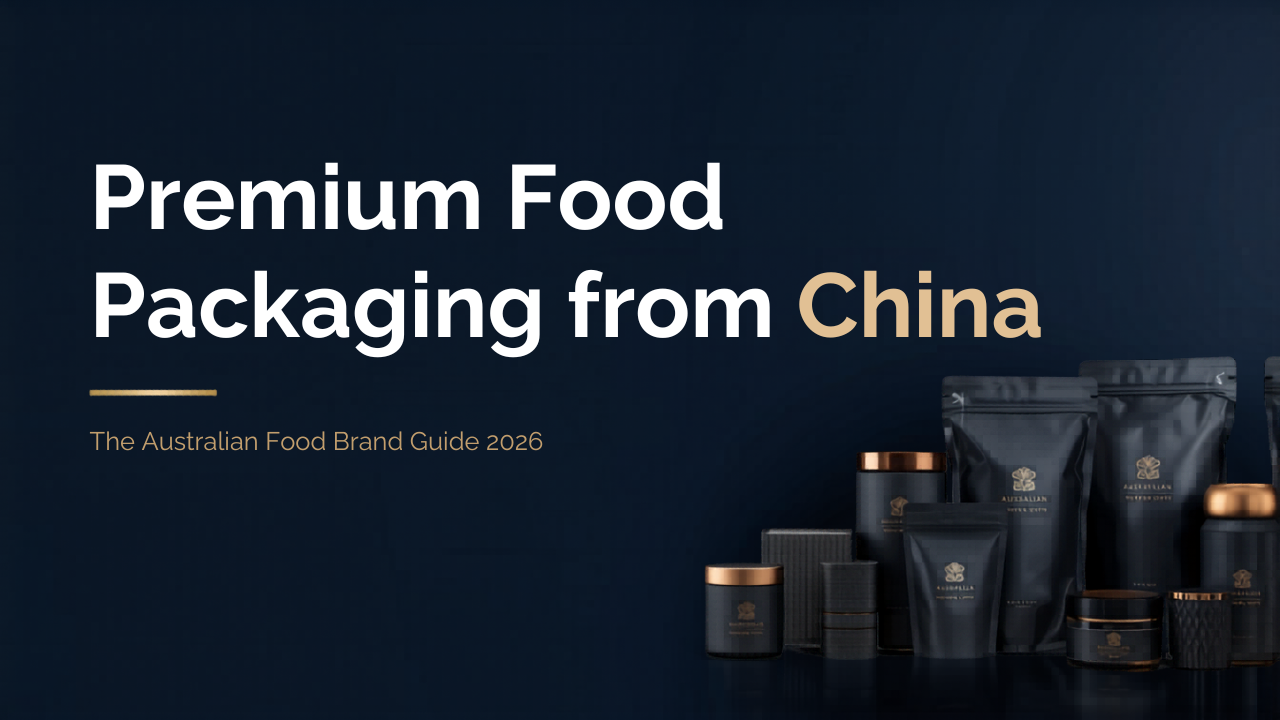
Australia's food brands can access China's world-class premium packaging factories to deliver luxury unboxing experiences at a fraction of local costs. Here's how to do it right in 2026.
Here's a truth that a lot of Australian food brand founders discover too late: the packaging is half the product.
You can have the best artisan granola, the finest cold-pressed olive oil, or the most premium kombucha on the Australian market — but if it comes in average packaging, it won't sell at a premium price point. And if you're paying Sydney or Melbourne packaging suppliers for luxury finishes, it might not be profitable either.
That's why an increasing number of Australian food brands are heading directly to Chinese factories for their premium packaging. Not the cheap end of the market — the good stuff. Embossed kraft boxes. Magnetic-closure gift sets. Foil-stamped pouches with matte laminates. Custom glass jars with ceramic lids. Printed tissue paper and branded inserts. The full premium experience, at a fraction of what you'd pay locally.
China now accounts for 35–40% of global food packaging production capacity, and the sophistication of Chinese manufacturers has kept pace with global demand for premium finishes. For Australian food brands, this is a genuine competitive advantage — if you know how to access it.
Let's get into it.
For years, "made in China" and "luxury packaging" seemed like a contradiction. That's no longer the case.
Over the past decade, China's packaging sector has undergone a transformation. Major packaging hubs — particularly in Guangdong, Zhejiang, and Fujian provinces — have invested heavily in advanced printing and finishing technology. We're talking UV coating lines, hot-foil stamping machines, embossing and debossing equipment, multi-layer laminate presses, and FSC-certified material supply chains.
The factories serving global luxury brands including premium cosmetics, high-end spirits, and specialty food retailers are the same factories Australian food brands can now access — at Chinese MOQs and Chinese prices.
Here's what that looks like in practice:
The savings are significant. And with the right factory partner and quality control processes, you're getting equivalent or superior quality.
Chinese factories can produce virtually every category of premium food packaging. Here are the most popular for Australian food brands:
Kraft stand-up pouches, retort pouches, spouted pouches, and flat-bottom bags are China's sweet spot. You can spec matte or gloss laminate, window cutouts, zipper closures, degassing valves for coffee, and full-colour digital or offset printing. Chinese pouch factories can produce food-grade certified packaging meeting Australian compliance standards for direct food contact.
Magnetic closure boxes, lift-lid boxes, shoulder boxes, and collapsible rigid boxes are a Chinese packaging specialty. Premium finishes include soft-touch laminate, spot UV varnish, hot-foil stamping in gold, silver, or custom Pantone colours, embossing and debossing, and ribbon pulls. This is the category where Chinese factories genuinely rival European and Japanese suppliers — at 40–60% less cost.
China is the world's largest glass container manufacturer. Custom glass jars, bottles, and vessels — including frosted glass, coloured glass, and screen-printed glass — are widely available. Premium options include ceramic lids, cork closures, wax seals, and custom metal caps. MOQs for custom glass typically start at 3,000–5,000 units.
Custom printed tins, cannisters, and metal boxes are a premium packaging staple for confectionery, tea, coffee, and dried goods. Chinese tin manufacturers offer deep embossing, complex lithographic printing, and matte varnish finishes. Minimum orders typically start at 1,000–2,000 units for standard shapes, higher for custom tooling.
Often overlooked, these elements complete the unboxing experience that premium food brands rely on. Custom tissue paper, branded stickers, thank-you cards, recyclable crinkle paper, and branded bags are all easily and affordably sourced from China.
Sourcing food packaging from China means you're responsible for ensuring the packaging meets Australian regulatory requirements. This is non-negotiable.
Any packaging that comes into direct contact with food must meet food contact material (FCM) standards. In Australia, this is governed by FSANZ (Food Standards Australia New Zealand). Key requirements include:
When working with Chinese factories, you should request third-party test reports (SGS, Intertek, or Bureau Veritas are the accepted international testing bodies) confirming food-contact compliance. Good factories will have these on hand. If a factory can't provide them, move on.
The packaging you import from China needs to accommodate Australian Country of Origin Labelling (CoOL) requirements, mandatory warning statements (where applicable), allergen declarations, and nutritional information panels formatted to Australian standards. Your label artwork needs to be compliant before you print — a mistake here is expensive to fix after the fact.
Packaging materials imported to Australia may be subject to DAFF biosecurity requirements (particularly for timber or plant-based materials), customs duties, and in some cases, import permits. Working with a freight forwarder experienced in packaging imports is important here. Our freight forwarding service handles this complexity for Australian food brands regularly.
Finding a reputable premium packaging factory in China isn't as simple as running a search on Alibaba. Here's how to approach it properly.
Before you approach a single factory, you need a detailed packaging brief. This means: dimensions, materials, print specifications (colours, finishes, treatments), food-contact requirements, target MOQ and order frequency, delivery timeline, and budget range. Without a brief, you'll get wildly inconsistent quotes and factories won't take you seriously.
Premium packaging factories are rarely the ones with the flashiest Alibaba stores. Look at Canton Fair exhibitors (packaging is consistently well-represented at the fair — our Canton Fair 2026 guide has everything you need to prepare), industry-specific B2B platforms like Made-in-China.com, and referrals from sourcing agents with packaging experience.
Request a factory audit or independent verification report before placing your first order. You need to confirm the factory has the equipment and certifications to produce what you're specifying, that they actually manufacture rather than trade (resellers add margin without adding value), and that their quality control processes are sound. Our supplier verification service can verify any Chinese packaging factory in under 48 hours — essential before you commit to tooling costs.
For premium packaging, samples are non-negotiable. Specify that samples must be produced using production-grade materials and processes (not hand-made samples), and pay for them if required — it signals you're serious and ensures the factory invests in producing accurate samples. Test samples rigorously: drop tests, seal tests, moisture tests, and visual quality checks.
One of the most common challenges for small and mid-sized Australian food brands is MOQs. Chinese premium packaging factories typically require:
Production lead times for premium packaging typically run 25–45 days after sample approval and deposit payment. Allow 2–4 weeks for ocean freight to Australian ports plus customs clearance.
If your MOQ requirements are lower than factory minimums, our Secret Source service can help you consolidate orders across multiple clients to meet factory minimums — a practical solution for emerging food brands not yet at scale.
Quality control for premium food packaging requires a different approach than standard product QC. You're not just checking function — you're checking aesthetic consistency and food safety compliance.
Key QC checkpoints include:
For high-value packaging or large first orders, commissioning a professional QC inspection is strongly recommended. The cost of a professional inspection is trivial compared to the cost of landing 50,000 units of misprinted premium packaging in Melbourne.
At Epic Sourcing, we've helped dozens of Australian food and beverage brands source premium packaging from Chinese factories — from specialty coffee roasters needing custom valve bags through to premium condiment brands building elaborate gift pack programs.
Our Out Source service manages the entire process: factory identification, vetting, sampling, QC, and logistics. We have established relationships with premium packaging manufacturers across Guangdong and Zhejiang, which means we can connect you with proven factories faster and negotiate better pricing than going direct.
If you're ready to elevate your food brand's packaging without blowing out your margins, give us a bell. A discovery call is free and you'll leave with a clear picture of what's possible, what it will cost, and how to get there.
Book your free discovery call →
Premium food packaging from China is no longer a compromise — it's a genuine competitive advantage for Australian food brands that know how to access it. The factories are world-class, the finishes are exceptional, and the cost differential versus local sourcing is substantial.
The keys to doing it right: invest in proper factory vetting, insist on food-contact compliance documentation, get samples produced under production conditions, and build QC into your process from day one.
Australian consumers are sophisticated. They expect premium packaging to feel premium. The good news is you can deliver that experience — at Chinese pricing.