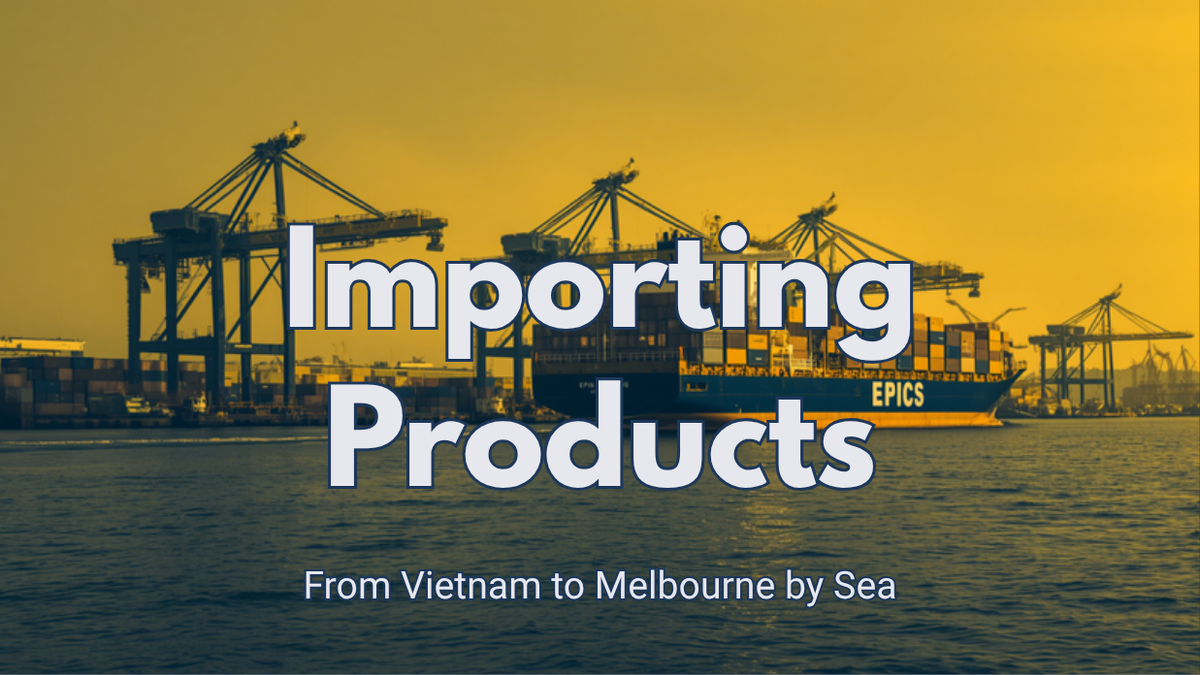
Discover why Australian businesses are adopting the China-Plus-One strategy in 2026 — keeping China while developing supply lines in Vietnam to build a more resilient, cost-effective sourcing strategy.

For years, I’ve watched Australian businesses build their entire product supply chains around a single country. China. And for a long time, it made perfect sense — competitive pricing, enormous manufacturing capacity, and a mature export infrastructure that could turn your product idea into a container on the water in under 90 days.
Then came the US-China trade war, COVID-19, shipping bottlenecks, and now — in 2026 — a fresh wave of US tariffs that have sent shockwaves across global supply chains. Suddenly, that single-country strategy looks a lot more fragile than it used to.
Enter the China-Plus-One strategy. If you haven’t heard this term yet, get comfortable — because every serious Australian importer needs to understand it right now.
The China-Plus-One strategy (also written as "China +1") is a business approach where companies keep their existing manufacturing footprint in China while simultaneously developing sourcing or production capacity in at least one alternative country.
It’s not about abandoning China. That would be a mistake. China’s manufacturing ecosystem — its supply chains, infrastructure, and skilled workforce — is still the most developed in the world for a huge range of product categories. The goal isn’t to leave. It’s to hedge your bets.
In 2026, with US tariffs on Chinese goods sitting at historic highs and global supply chain uncertainty showing no signs of settling, this strategy isn’t just smart — it’s becoming essential.
When the US imposes tariffs on Chinese goods — which currently sit as high as 145% on certain categories — it triggers a cascade of effects that ripple well beyond American shores.
1. Chinese manufacturers redirect capacity and chase new buyers — creating increased competition from cheaper, redirected goods in the Australian market.
2. Global shipping lanes get disrupted — rates change, lead times blow out, and Australian businesses feel this in their freight costs.
3. Geopolitical risk becomes real supply chain risk — according to DFAT, the current tariff environment is creating "significant uncertainty for Australian businesses with exposure to global supply chains."
4. Manufacturing costs in China are rising anyway — labour costs have been rising steadily for over a decade, narrowing the cost advantage that made China irresistible.
Vietnam is, by a wide margin, the most popular China-Plus-One destination for Australian businesses. In Q1 2026 alone, Vietnam attracted USD 15.2 billion in registered foreign direct investment — a 42.9% increase year-on-year.
Key product categories where Vietnam excels for Australian buyers include furniture and homewares, apparel and footwear, bags and accessories, electronics assembly, outdoor and garden products, and bamboo and sustainable goods.
Under AANZFTA and CPTPP, many Vietnamese goods enter Australia at 0% tariff — a significant edge over competing Chinese imports.
At Epic Sourcing, our Vietnam sourcing service has seen demand more than double since 2024. Our team on the ground in Ho Chi Minh City can help you identify, vet, and connect with the right factories.
India is positioning itself aggressively as a manufacturing alternative to China, particularly in textiles, pharmaceuticals, electronics components, and engineering goods.
Thailand has long been a reliable manufacturing hub for automotive components, electronics, food products, and rubber goods — mature but more expensive than Vietnam for labour-intensive manufacturing.
1. Audit your current China supply chain — list every product category, supplier, and annual spend.
2. Identify which products to transition — focus on tariff-sensitive products and those where Vietnam or India has genuine cost and capability advantage.
3. Research alternative suppliers — our OutSource service is specifically designed for Australian businesses looking to find and qualify suppliers in new markets.
4. Run small trial orders first — never commit significant capital to a new supplier without a trial run.
5. Build relationships, not just transactions — treat overseas suppliers as business partners.
6. Plan your logistics and compliance — moving to a new sourcing country means navigating new logistics routes and customs requirements.
The biggest risk for Australian importers in 2026 isn’t doing the China-Plus-One strategy wrong. It’s not doing it at all. Businesses that remain entirely dependent on a single-country supply chain are exposed to geopolitical shocks, factory disruptions, currency volatility, and shipping bottlenecks.
At Epic Sourcing, we’ve been helping Australian businesses source smarter for years. Our teams are on the ground in both China and Vietnam — and we understand the nuances of both markets intimately.
Our supply chain management service takes the complexity off your plate entirely — from initial supplier research and vetting through to quality control, consolidation, and freight coordination.
Want to find out if the China-Plus-One strategy makes sense for your business? Give us a bell at gday@epicsourcing.com.au or book a free discovery call today.
Never Miss An Update — Subscribe for up-to-date access to expert guides, industry insights and clever sourcing solutions from the team at Epic Sourcing Australia.