


Custom packaging from China can dramatically lift your product's perceived value — but getting it right takes more than sending a logo file to a factory. Here's the practical guide.
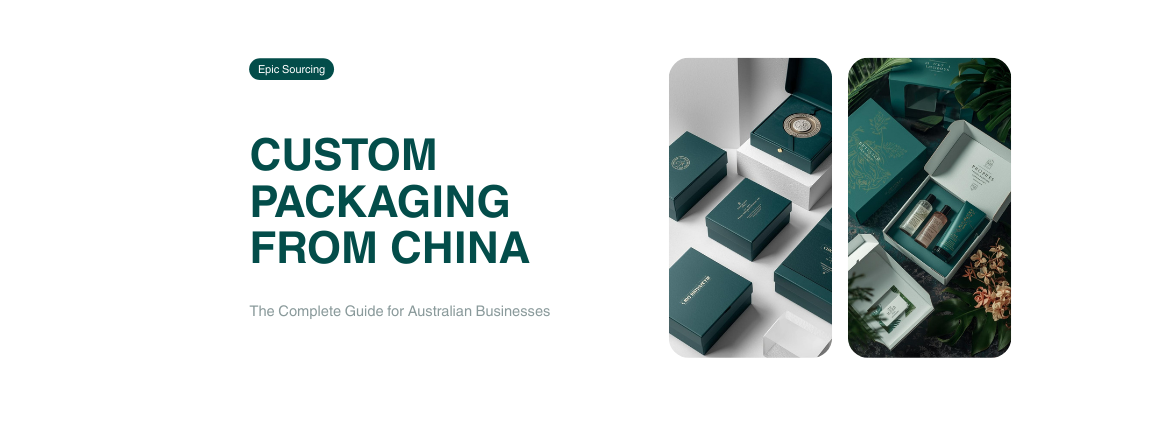
Packaging is one of the most impactful and underestimated parts of a product. It's the first thing your customer sees. It shapes their perception of your brand before they've even touched the product inside. And for eCommerce and retail businesses, it's often the difference between a premium feel and a generic one.
The problem is that custom packaging in Australia is expensive. Short print runs are even more expensive. And the further you push the design — special finishes, custom shapes, premium materials — the more prohibitive the cost becomes domestically.
That's why thousands of Australian businesses source their custom packaging from China. Chinese packaging manufacturers offer dramatically lower unit costs, a much wider range of materials and finishes, strong capability in custom shapes and structures, and experience working with international brands who demand consistency and quality.
Done well, it's a genuine competitive advantage. Done poorly, it's a costly headache. This guide covers how to do it well.
Chinese packaging manufacturers produce virtually every type of packaging used in retail, eCommerce, food, cosmetics, and industrial applications. The most commonly sourced by Australian businesses include:
Folding cartons and rigid boxes. The workhorses of retail packaging. From simple tuck-end cartons to premium rigid (setup) boxes with magnetic closures, Chinese factories produce these at exceptional quality and price points. Rigid boxes are particularly popular for luxury products, gifting, and premium consumer goods.
Mailer boxes and shipping boxes. Custom-printed corrugated mailer boxes have become essential for eCommerce brands. China produces these at much lower cost than Australian printers, and the print quality has improved significantly in recent years.
Pouches and flexible packaging. Stand-up pouches, flat pouches, and resealable bags for food, supplements, pet food, and cosmetics. China dominates global flexible packaging production, with strong capabilities in barrier films, custom print, and specialty closures.
Labels and stickers. From simple product labels to complex holographic or textured stickers, Chinese label manufacturers can handle almost any specification at competitive pricing.
Paper bags and tissue paper. Custom-printed paper bags and branded tissue paper for retail and gifting applications. Often ordered alongside box packaging as part of a complete unboxing experience.
Custom inserts and void fill. Foam inserts, custom-shaped pulp inserts, and printed cardboard inserts for protecting products in transit and adding a premium feel to the unboxing experience.
Tubes, tins, and specialty containers. For cosmetics, candles, and food products. China has strong manufacturing depth in metal, aluminium, and cardboard tube packaging.
Before you contact any factory, get clear on exactly what you need. This means product dimensions and weight (to determine packaging size and structural requirements), quantity (your order volume determines what's feasible and cost-effective), material preferences (cardboard weight, coating type, finish), print requirements (CMYK, Pantone colours, print sides), any special finishes (foil stamping, embossing, spot UV, soft-touch lamination), and functional requirements (resealable, tamper-evident, food-safe, moisture barrier). The more specific your brief, the more accurate and comparable your supplier quotes will be.
Not all Chinese packaging factories are equal. Some specialise in folding cartons, others in rigid boxes, others in flexible packaging. Finding a factory that specialises in your packaging type — and has experience with international export clients — matters enormously for quality consistency and communication.
Alibaba is a starting point, but requires careful vetting. Factory audits, sample assessment, and reference checking are all important before committing to a production order. A sourcing agent with established packaging factory relationships can shortcut this process significantly.
Send your brief to multiple factories and compare quotes. Pricing will vary more than you'd expect between factories — sometimes by 30–50% — so getting multiple quotes is essential. Once you've shortlisted based on price and initial responsiveness, request samples. For packaging, this typically means a blank (unprinted) structural sample first to confirm the box dimensions and construction, then a printed sample once the structure is approved.
This stage is where most mistakes happen. Supply your artwork in the correct format (PDF or AI files, CMYK colour mode, with bleed and crop marks). Request a digital proof from the factory and review it carefully — check colours, text, alignment, and any fine details. For critical colour matching, request a physical pre-production sample (a "PP sample") before approving the full production run. Never skip this step for large orders.
Once artwork is approved, production begins. Lead times for custom packaging from China typically run 2–4 weeks for folding cartons, 3–6 weeks for rigid boxes, and 4–8 weeks for specialty packaging. Add 3–4 weeks for sea freight to Australia.
Before shipment, conduct a pre-shipment inspection. Check print quality (colour consistency, registration), structural integrity (does it fold, close, and stack correctly?), quantities, and packaging of the packaging itself (how are the boxes packed for shipping — this affects transit damage rates).
Packaging is typically bulky relative to its weight, so sea freight is almost always the right choice over air. Packaging is also generally low-value, which means freight cost as a percentage of goods value can be significant — factor this into your landed cost calculations carefully. Most packaging materials attract low or zero import duty under ChAFTA.
Ordering without a physical sample. Digital proofs cannot tell you how a box feels, how the colours look printed on your chosen material, or whether the structure works for your product. Always get a printed sample before committing to production.
Underestimating lead times. First-time packaging orders always take longer than expected. Allow plenty of buffer, especially if you're launching a new product. Running out of packaging is a miserable way to miss a launch window.
Getting the dimensions wrong. Packaging that doesn't fit your product is useless. Measure your product carefully, account for any protective wrapping inside the box, and confirm the internal dimensions with the factory before finalising the structure.
Ignoring colour mode. Chinese packaging factories print in CMYK. If your brand colours are specified in RGB or Pantone, make sure you convert correctly and provide the CMYK equivalents. Pantone matching is available from better-quality factories but costs more.
Ordering too much on the first run. Until you've confirmed that a factory's quality is consistent across a full production run, don't over-commit on quantities. A smaller first order gives you the chance to identify and correct any issues before scaling up.
Not checking packaging compliance. For food, cosmetics, and children's products, packaging must meet specific labelling requirements under Australian Consumer Law. Don't leave compliance checking until after the packaging is printed.
Pricing depends on packaging type, quantity, material, and finish complexity. Here's a rough guide to help with planning:
Simple folding cartons (CMYK print, no special finishes) typically run A$0.30–$1.50 per unit at MOQs of 1,000–3,000 pieces. Premium rigid boxes with special finishes (foil, embossing, soft-touch) typically run A$2–$8 per unit at MOQs of 500–1,000 pieces. Custom mailer boxes typically run A$0.80–$2.50 per unit at MOQs of 500–2,000 pieces. Stand-up pouches with custom print typically run A$0.40–$1.50 per unit at MOQs of 1,000–5,000 pieces.
Setup costs (die-cutting tools, printing plates) are typically a one-off charge of A$200–$800 per design, amortised across the order. These costs don't recur on repeat orders of the same design.
At Epic Sourcing, we source custom packaging for Australian businesses as part of our broader product sourcing service — and increasingly as a standalone service for brands that have their product sorted but need help with packaging.
We have established relationships with packaging manufacturers specialising in rigid boxes, folding cartons, mailer boxes, flexible packaging, and labels. We manage the supplier vetting, quote comparison, sample coordination, artwork review, and pre-shipment inspection — so you're not navigating the process blind from an Australian time zone.
If you're working on a new product launch or want to upgrade your existing packaging, get in touch with our team and let's talk about what you're trying to achieve.
MOQs vary by packaging type. Folding cartons typically start at 1,000–3,000 pieces. Rigid boxes often start at 500–1,000 pieces. Custom mailer boxes typically start at 500–2,000 pieces. Flexible pouches typically start at 1,000–5,000 pieces. Some factories will do smaller runs, but unit costs increase significantly below typical MOQ thresholds.
Allow 6–12 weeks total from first contact to delivery in Australia for a first order. This includes factory selection, sampling, artwork approval, production (2–6 weeks depending on complexity), and sea freight (3–4 weeks). Repeat orders with the same factory and design are typically faster.
Most Chinese packaging factories require print-ready PDF or Adobe Illustrator (AI) files in CMYK colour mode, with bleed and crop marks included. Your graphic designer should be able to produce these. The factory will typically provide a dieline template for the specific box structure once you've agreed on dimensions.
Yes, but it's not available from all factories and adds cost. Better-quality packaging factories can match Pantone colours, but you should specify this requirement upfront and request a printed pre-production sample to verify the match before approving the full run.
Most packaging materials (cardboard, paper, plastic) attract low or zero import duty under the China–Australia Free Trade Agreement (ChAFTA). GST of 10% still applies. Your customs broker will calculate the correct duty rate based on the HS code for your specific packaging type.


