A 2026 guide for Australian beauty brands importing LED masks, microcurrent tools, gua sha and derma rollers from China, covering RCM compliance, lithium battery shipping rules, TGA medical device risk and landed costs, with a look at Geelong's growing beauty ecommerce scene.
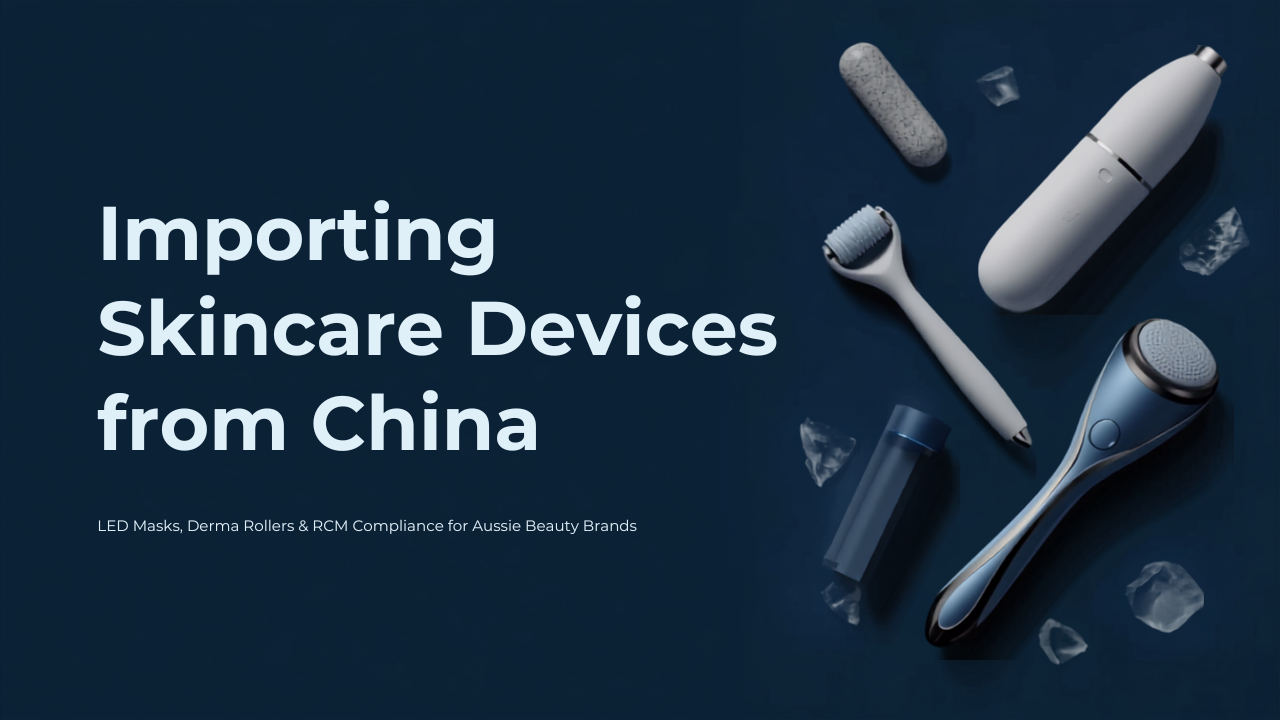
In short: Yes, Australian beauty brands can import LED face masks, gua sha tools, derma rollers and other skincare devices from China — it's one of the fastest-growing import categories in the beauty space. The catch is that these are electrical or near-electrical products, so RCM compliance, battery safety and lithium-ion shipping rules matter far more than they do for formulated skincare. Get those right and landed costs typically run 50-77% below Australian wholesale pricing.
Last updated: 8 July 2026
Geelong has quietly built a strong base of beauty ecommerce brands and clinic-adjacent retailers over the past few years, riding the same "skinification" wave that's driven demand for at-home facial devices Australia-wide. Rather than reselling other brands' devices, more Geelong-based sellers are now importing white-label LED masks, microcurrent tools and derma rollers directly and building their own brand around them.
Beauty devices sit in an unusual sweet spot: margins are strong (a $180-250 retail LED mask can often be landed for $28-45), and unlike formulated skincare, there's no cosmetic formulation, stability testing or ingredient panel to manage — the compliance burden shifts almost entirely to electrical and battery safety instead.
The single biggest growth category. Manufactured extensively in Guangdong, these run on low-voltage battery or mains power and need RCM (Regulatory Compliance Mark) certification to be sold legally in Australia.
Slightly more complex electronics, often with rechargeable lithium batteries — which brings UN38.3 lithium battery test reports into play for shipping, on top of RCM for the device itself.
No electronics involved, which makes these by far the simplest device category to import — closer to a general consumer good than a regulated electrical product. A good entry point for first-time importers.
These sit in a genuine grey area. Devices with needles longer than 0.25mm can be classified as medical devices by the TGA, which is a different (and much stricter) regulatory pathway than a standard consumer product. Always check needle depth and intended use claims before importing.
Any device with a battery or mains power needs RCM certification before sale — this is a legal requirement, not a nice-to-have. If the device has a rechargeable lithium battery, you'll also need a UN38.3 test report from the manufacturer to ship it by air or sea without it being rejected by the freight forwarder.
If your device makes any therapeutic claim (skin tightening, cellulite reduction, "clinically proven") or uses needles, check whether it falls under TGA medical device rules before you commit to an order — this single check can be the difference between a straightforward import and a six-month regulatory process.
Worked example for a mixed shipment of 1,000 LED masks and 2,000 gua sha tools by air freight (devices are lightweight, so air freight is often more cost-effective than sea for smaller first orders):
Cost itemTypical range (AUD)Product cost (FOB China, 1,000 LED masks + 2,000 gua sha tools)$9,500 - $15,000RCM certification & testing (LED masks)$1,200 - $2,500Air freight, China to Melbourne$1,800 - $3,200Customs duty + GST$1,150 - $1,900Customs broker + local delivery$400 - $700Estimated total landed cost$14,050 - $23,300
At an average retail of $180-250 per LED mask, that landed cost typically clears a 4-6x markup — well above what most Australian beauty brands achieve reselling third-party stock.
Because RCM compliance sits on the importer, not the factory, it pays to see the manufacturer's existing test reports before you pay a deposit — and ideally have an independent lab confirm them rather than taking the factory's word for it. This is where a lot of first-time importers get caught out: a supplier will happily supply a "certificate" that doesn't match the actual product being shipped.
Before you commit, it's worth reading our guide on how to verify a Chinese supplier before you pay — the same red flags that apply to any category apply doubly to electronics, where a certification mismatch can mean your entire shipment gets held at the border.
Yes. Any electrical device sold in Australia, including battery or mains-powered beauty devices, needs to comply with RCM requirements. Selling non-compliant electrical goods carries real regulatory and liability risk.
Significantly easier. With no battery or electrical components, they're treated as general consumer goods rather than regulated electrical products, which removes RCM and lithium battery testing requirements entirely.
It depends on needle length and marketing claims. Devices with needles longer than 0.25mm, or that make therapeutic claims, can fall under TGA medical device regulation. Check this before ordering stock.
LED masks and microcurrent devices typically start at 300-500 units for a custom mould or branding run. Gua sha and jade roller tools can often be ordered from 100-200 units.
Landed costs are commonly 50-77% below what you'd pay buying the same devices pre-imported through an Australian distributor, once certification and freight are factored in.
Epic Sourcing has sourced more than 20,000 products for over 300 happy clients, with bilingual teams on the ground in China and Vietnam and offices in five countries. For beauty devices specifically, our China team coordinates RCM testing, verifies lithium battery documentation, and inspects finished goods before they ship — so compliance is sorted before your stock lands, not after. If you're also bringing in formulated skincare alongside your devices, see our guide on importing cosmetics and skincare from China, and our broader health and beauty import guide.
Ready to launch your own beauty device range? Talk to the Epic Sourcing team about sourcing, certification and freight for your first shipment.