A practical 2026 guide for Australian brands importing sunglasses and eyewear from China, covering MOQs, AS/NZS 1067 UV compliance, landed costs and factory vetting, with a worked example and FAQ.
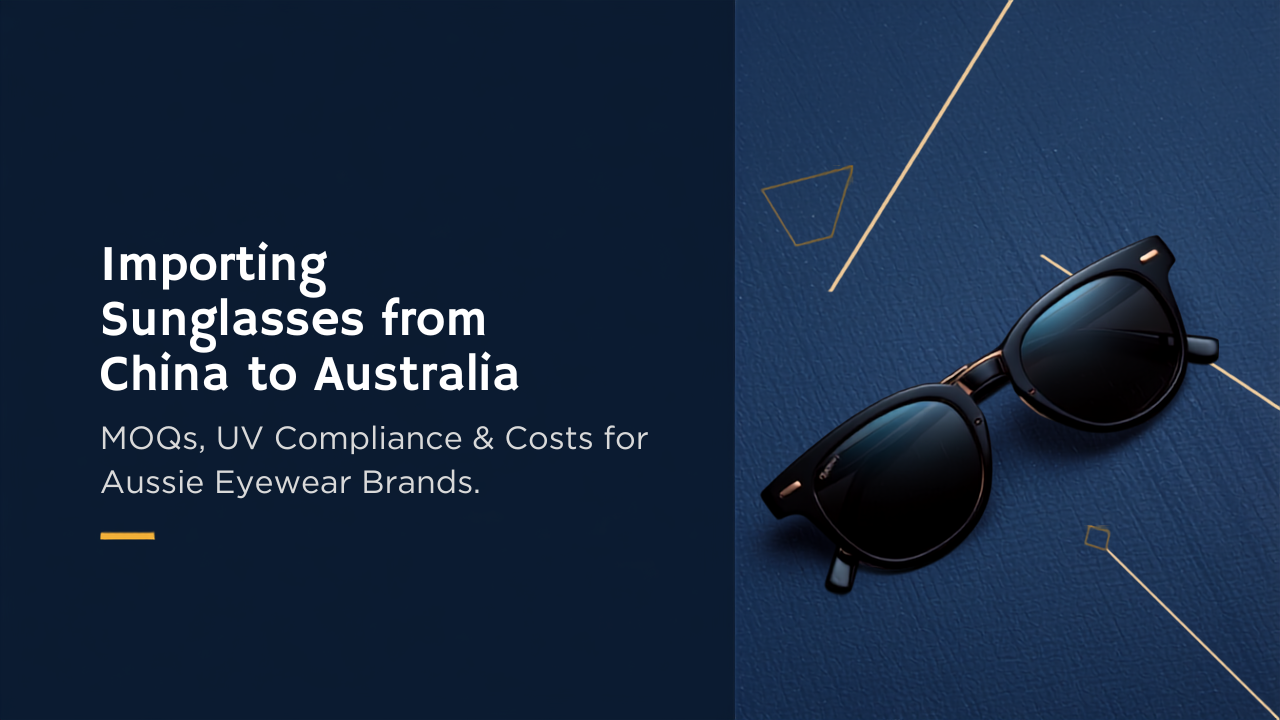
In short: Australian eyewear brands can import sunglasses and fashion eyewear from China at MOQs starting around 300–500 units per style, with FOB unit costs typically USD 1.20–4.50 depending on lens type (polarised, photochromic, polycarbonate) and frame material (acetate, TR90, metal). The compliance bar is lower than most first-time importers expect — sunglasses aren't regulated as a medical device in Australia — but UV protection claims must genuinely stack up against the AS/NZS 1067 sunglass standard, and getting this wrong is the most common reason eyewear shipments get held for testing at the border.
Last updated: 12 July 2026
Wollongong's beach culture, surf-adjacent fashion scene and growing independent retail strip along Crown Street have quietly produced a wave of small eyewear and accessories brands over the past couple of years. A handful of Illawarra founders we've spoken with started by reselling third-party sunglasses brands at markets and pop-ups, then hit the obvious next step: importing their own private label range once they had proof a style sold. Sunglasses are one of the friendliest categories for a first import run — no electronics, no lithium batteries, no TGA pathway — which makes them a common "first product" for Australian founders testing whether they can run an import business at all.
Unit cost depends almost entirely on lens type and frame material. Basic polycarbonate lenses in a TR90 (flexible plastic) frame run USD 1.20–2.00 FOB per unit at 500+ units per style. Polarised lenses add roughly USD 0.50–1.00 per unit. Acetate frames (the thicker, glossier finish used by most premium-looking fashion brands) push cost to USD 2.50–4.50 FOB, and photochromic (colour-changing) lenses sit at the top of the range.
Cost elementTR90 + polarised (500 units)Acetate + polarised (500 units)FOB unit costUSD 2.10USD 3.60Freight (sea, LCL share)USD 0.35USD 0.40AU duty (5%) + GST (10%)USD 0.38USD 0.65Approx. landed cost (AUD)$4.30$7.20Typical AUD retail (4-5x)$17-22$29-36
These numbers move with case and packaging inclusions (a branded hard case can add USD 0.80–1.50 per unit) and whether you're ordering custom lens tints or sticking with a factory's existing colour range. Always ask for a full landed cost breakdown before committing to a production run.
Sunglasses aren't a TGA-regulated medical device, and there's no mandatory RCM electrical certification since there's nothing electrical involved — which is exactly why this category is a popular entry point for new importers. But Australian Consumer Law treats sun protection claims seriously, and the relevant benchmark is the AS/NZS 1067 sunglass standard.
AS/NZS 1067 categorises lenses from 0 (fashion spectacles, minimal UV protection) to 4 (special-purpose, very high UV protection). Most everyday sunglasses sold in Australia sit in category 2 or 3. If your product claims "UV400" or "100% UV protection," the factory needs to supply test documentation backing that claim — not just a line on a spec sheet.
Children's sunglasses and anything marketed for sport or high-impact use face stricter lens impact-resistance requirements. If you're building a kids' range, flag this with your factory before tooling starts, not after the first sample round.
Children's products (including eyewear) fall under Australia's general product safety rules around lead content in paints and coatings. Ask for material composition documentation on any painted or coated frame components intended for a kids' line.
Most Chinese eyewear factories will quote 300 units per colourway as an entry MOQ on an existing frame mould, with 500+ units unlocking better per-unit pricing. Custom frame moulds (a genuinely unique shape rather than a re-coloured existing style) typically require 1,000+ units to justify the tooling investment, plus 30-45 days for mould development before production even starts. Budget 45-60 days production plus 25-35 days sea freight to Port Kembla, Sydney or Melbourne — call it 75-100 days from approved sample to stock on the shelf for an existing-mould order.
Guangdong province (particularly Shenzhen and Xiamen) is the centre of China's eyewear manufacturing, with factories ranging from small workshops re-badging generic frames to larger operations doing genuine private-label development for international brands. The verification process is the same as any other category: request a business licence, ask for the AS/NZS 1067 test report on the specific lens tint and material you're ordering (not a generic company certificate), and where possible get a pre-shipment inspection before the container leaves port. Our guide on how to verify a Chinese supplier before you pay covers the red flags that apply doubly to a category where a mismatched test certificate can mean the whole shipment gets held.
No. RCM applies to electrical and radiocommunications products. Standard sunglasses have no electrical components, so RCM doesn't apply — though any claimed UV protection rating should be backed by AS/NZS 1067 test documentation.
Expect 300 units per colourway as a floor on an existing frame mould, and 1,000+ units if you want a genuinely custom frame shape rather than a re-coloured existing style.
Landed cost on a mid-range polarised style typically runs 60-75% below equivalent Australian wholesale pricing, once freight, duty and GST are factored in.
Yes — most factories offer branded cases, microfibre pouches and printed packaging as an add-on, typically USD 0.80-1.50 per unit depending on materials and print complexity.
Vietnam's eyewear manufacturing base is far smaller than Guangdong's, with less frame-style variety and generally higher MOQs. For most new eyewear brands, China remains the more practical starting point, though this can shift for brands also running an apparel range through Vietnam.
Epic Sourcing has sourced more than 20,000 products for 300+ Australian businesses, with bilingual teams on the ground in China who verify eyewear factories, check AS/NZS 1067 documentation against the actual product being shipped, and manage quality inspection before goods leave port — delivering average client savings of around 77%. Our China sourcing service covers eyewear and accessories alongside broader product categories. Book a discovery call before you commit to your first sunglasses production run.