


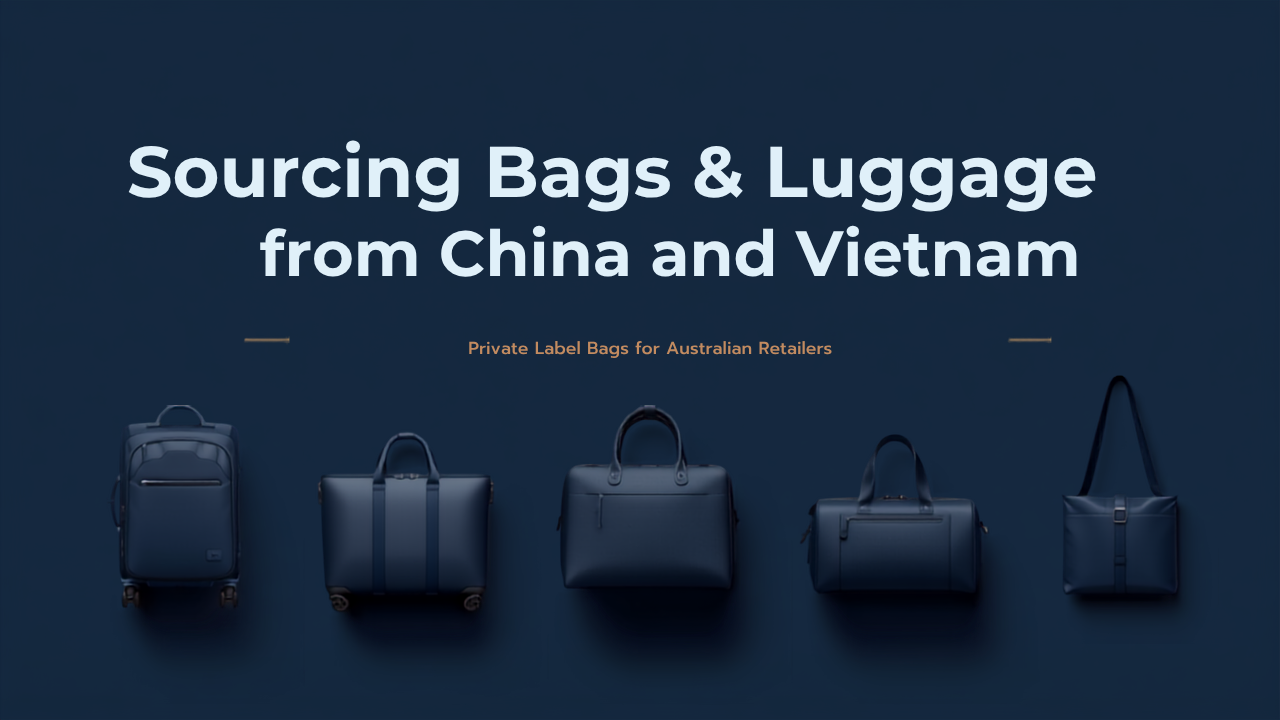
A cost-broken-down guide to private label bags, luggage and backpacks sourced from China and Vietnam, including safety compliance and a Canberra retailer example.
Last updated: 6 July 2026
In short: Yes — bags, luggage, and backpacks are one of the most private-label-friendly categories you can source, with strong options in both China and Vietnam depending on what you're building. China is generally stronger for hardware-heavy products (zippers, buckles, wheeled luggage frames), while Vietnam has become a genuine competitor for stitched soft-goods like backpacks and tote bags, especially since several major global bag brands shifted production there. For a Canberra business selling online or through a bricks-and-mortar store, going direct typically cuts unit costs by 40-60% versus buying from an Australian wholesaler or distributor.
Bags aren't one product — they're an assembly of fabric, foam, hardware, zippers, webbing, and (for luggage) injection-moulded or aluminium frames. China's Guangdong and Fujian clusters (Guangzhou, Dongguan, Quanzhou) dominate global zipper and hardware manufacturing (YKK has factories there, and so do dozens of reliable alternatives), which makes it the easier starting point for wheeled luggage and technical bags. Vietnam's northern hubs around Hai Phong and Nam Dinh have built up serious soft-goods sewing capacity, largely from apparel factories diversifying into bags, and often quote competitively on backpacks, totes, and duffels once you're past a moderate order size.
Running both markets side by side — rather than picking one — is exactly the China-plus-one approach more Canberra and Australian retailers are adopting to de-risk supply and negotiate harder on price.
Pricing varies enormously by construction, but here's a realistic snapshot for a mid-range private label backpack.
Cost itemApprox. AUDUnit cost (ex-factory, 600 units, 900D polyester)$8.20 x 600 = $4,920Custom hardware & branded zipper pulls (tooling + unit cost)$350 + $0.30/unitSea freight (LCL, Ho Chi Minh City or Guangzhou to Sydney/Canberra)$700-$1,100Customs duty (5% general rate)~$260GST (10% on CIF + duty)~$615Total landed cost (approx.)$6,900-$7,400Landed cost per unit$11.50-$12.35
A comparable branded backpack retails for $89-$149 through Australian wholesale channels bought at $28-35 landed. Cutting that in half by going direct is the whole business case for private label.
Any bag marketed for children under three needs to comply with Australian Consumer Law drawstring safety requirements — no functional drawstrings around the hood or neck area, and cord length limits on bag closures. This is one of the most commonly flagged issues at the border, so build it into your tech pack from day one.
Azo dyes and certain phthalates used in cheap PVC bag linings are restricted under Australian consumer product safety rules. Ask your factory for test reports (or have your sourcing agent commission independent lab testing) before committing to a full production run.
If you're marketing "carry-on approved" luggage, check current airline dimension and weight limits carefully — Australian Consumer Law treats false size claims as misleading conduct, and it's an easy compliance trap for new luggage brands to fall into.
If your product is hardware-heavy (wheeled cases, frame backpacks, technical camera bags), start your factory search in China — the supplier ecosystem for zippers, wheels, and telescoping handles is deeper and MOQs on hardware components are generally lower. If you're building simple soft-goods (tote bags, duffels, drawstring bags, basic backpacks), Vietnam is genuinely worth quoting alongside China, particularly if you already run apparel production there and can consolidate freight.
Most factories in both China and Vietnam ask for 300-500 units per style/colourway for a fully custom bag with your own branding, hardware, and packaging. Simpler tote bags or drawstring bags can sometimes start as low as 100-200 units.
Sampling usually takes 2-3 weeks, bulk production runs 25-40 days depending on complexity, and sea freight adds another 20-30 days from Vietnam or 25-35 days from China. Budget roughly 3 months from approved sample to stock in Canberra.
Yes, and larger brands do this regularly — sourcing zippers, buckles, and frames from Chinese suppliers and shipping them to a Vietnamese sewing factory for final assembly. It adds complexity to your supply chain, so it's usually only worth it once you're running consistent, sizeable orders.
You're not legally required to third-party test every bag, but for anything targeting children, or any product with metal components, hardware testing and a documented quality inspection before shipment is strongly recommended — and it's a lot cheaper than a recall.
Not always. Unit labour costs can be similar or even higher in Vietnam once you account for smaller factory scale and higher minimum order requirements on some styles. The real advantage of adding Vietnam isn't always price — it's supply chain diversification and negotiating leverage with your China suppliers.
Epic Sourcing has sourced 20,000+ products for 300+ happy clients across Australia, with bilingual teams on the ground in China and Vietnam and offices in five countries. For bags and luggage specifically, we run factory vetting in both markets, coordinate hardware and fabric sourcing, manage sample rounds, and handle QC inspections before your container ships — helping clients save an average of 77% versus local wholesale buying. Curious what a dual China-Vietnam supply chain actually looks like day to day? Read our footwear sourcing guide for a comparable category breakdown, or check what a bonded warehouse could do for your cash flow on larger seasonal orders. Ready to talk specifics? Get in touch for a free scoping call.


